Introduction
Kurdish dance, commonly referred to as helperke or wašt, constitutes one of the most enduring and symbolically charged expressive traditions in the cultural landscape of Kurdistan. Far beyond a form of entertainment or celebration, Kurdish dance functions as an embodied language through which communities articulate historical memory, spiritual belief, emotional expression, and collective identity (Karakeçili, 2008; Allison, 2012). Embedded in rituals of birth, harvest, mourning, marriage, pilgrimage, healing ceremonies, and political demonstrations, Kurdish dance has served as a resilient cultural conduit across centuries marked by displacement, suppression of language and customs, and the fragmentation of Kurdish lands. Movement, rhythm, costume, and communal formations transmit narratives that formal historical archives often omit, preserving heritage through the living body rather than through written text. This expanded essay examines the historical foundations, structural symbolism, gendered embodiment, typological diversity, and political significance of Kurdish dance, arguing that it functions simultaneously as a cultural archive, a spiritual practice, and a dynamic medium of social continuity and resistance.
1. Historical Foundations and Ritual Origins
The roots of Kurdish dance extend into prehistoric communal movement rituals that emerged during the late Paleolithic and early Mesolithic eras. These proto-dances were linked to seasonal cycles, hunting success rites, protective magic, and collective bonding practices that preceded written language. The Kurdish term helperke derives from helper—denoting movement, shaking, or attack—suggesting ancient connections to martial preparedness as well as bodily expression rooted in survival culture (Karakeçili, 2008). Archaeological findings support this interpretation: stone reliefs from the Hawraman region dating to the first millennium BCE depict groups of dancers accompanied by musicians, visually confirming that coordinated movement and musical rhythm formed part of sacred and social life long before the development of formal historiography.
Classical literary references also reinforce continuity. In Nowruz-nāmeh, Omar Khayyam describes communal dancing following Fereydun’s mythic victory over Zahhak, framing collective dance as ritual triumph and political symbol. Throughout the medieval and early modern periods, Kurdish dance accompanied nearly every major social transition including courtship, weddings, circumcision feasts, funerals, pilgrimages to shrines, returning warriors’ celebrations, and seasonal festivals such as Nowruz (Allison, 2012). Over time these dances absorbed influences from Sufi ritual, tribal warrior cultures, and agricultural rhythms, evolving without losing their core communal framework. Kurdish dance thus represents not a static folkloric artifact but a continuously adaptive cultural practice transmitting archaic motifs into modern contexts.
2. Structure, Rhythm, and Symbolism
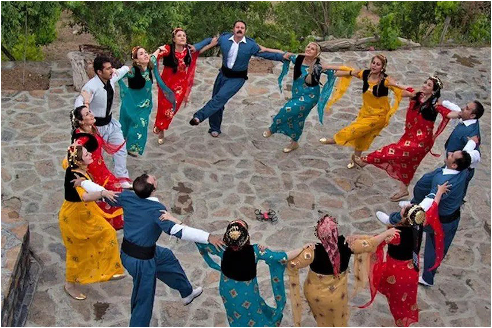
Kurdish dances are predominantly collective and are structured through linear chains, arcs, or circular formations in which dancers interlock hands or shoulders. This physical linkage dramatizes solidarity and interdependence: no dancer moves independently from the group, and the cohesion of the chain symbolizes communal survival (Karakeçili, 2008). Leadership is entrusted to the serçopîkeş, who determines tempo, initiates movement transitions, and signals rhythmic changes using a handkerchief, staff, or arm gestures. The concluding dancer, bençopî, serves an anchoring role, stabilizing the chain during rapid rotations or jumps and preserving spatial balance.
Musical accompaniment centers on the piercing tones of the zurna and the thunderous accents of the dohol drum. Their cyclical patterns induce kinetic entrainment, synchronizing steps, breathing, and bodily movement into shared tempos that evoke collective emotional intensity. Variations across geography illustrate the intimate relationship between ecology and dance form. Mountain communities favor vertical jumps, rapid foot stamping, and tight formations that reflect rugged terrain and warrior traditions, while lowland and agricultural regions emphasize broader gestures, gentler rhythms, and elongated stepping patterns suggesting fertility and openness (Karakeçili, 2008; Allison, 2012).
Each gesture embodies layered symbolism. Stamping affirms connection to ancestral soil and territorial belonging. Circular formations evoke cosmic continuity and communal protection. Arm arcs convey unity and cyclical regeneration. Collective vocalizations known as hora act as emotional catharsis and communal proclamation, historically used both during celebrations and as ritual intimidation in martial contexts. Through these symbolic codes, Kurdish dance serves as a kinetic narrative of collective defense, continuity, spirituality, and renewal.
3. Gender, Embodiment, and the Role of Women
Women occupy a central position in Kurdish dance traditions not merely as participants but as transmitters, leaders, educators, and guardians of embodied memory. Kurdish dance lines typically integrate women and men within a single unbroken chain formation, reflecting ideals of complementarity, balance, and collective presence (Karakeçili, 2008). Contrary to external stereotypes portraying Kurdish culture as rigidly patriarchal, women frequently assume leadership roles, including the position of serçopîkeş. In these moments women regulate rhythm, direct movement flow, and command the attention of the entire ensemble, signaling performative authority embedded within communal practice.
Beyond performance spaces, women maintain dance traditions through informal intergenerational pedagogy. Mothers and grandmothers transmit dance steps, rhythmic cues, posture etiquette, costume symbolism, and hand formations within household environments and community gatherings long before young dancers engage in public festivities. This embodied teaching system became particularly vital during periods when Kurdish cultural expression faced political restriction or outright prohibition, ensuring continuity through private transmission when formal instruction was impossible (Allison, 2012; Khdhir, 2015).
Women’s dance aesthetics emphasize precision, continuity, and kinetic restraint that values collective harmony over virtuoso display. Subtle shoulder articulations, carefully coordinated steps, and fluid chain movements communicate dignity and emotional maturity. Traditional costumes—embroidered gowns layered with brilliant fabrics, sequins, coins, and colorful sashes—encode tribal affiliations, spiritual motifs, fertility symbols, and regional identity markers. Through their preservation of costume traditions, women act as visual curators of Kurdish semiotic heritage (Karakeçili, 2008; Allison, 2012).
In diaspora communities, female dancers increasingly function as cultural activists. Dance troupes and cultural associations across Europe and beyond provide platforms for Kurdish women to assert ethnic visibility, cultivate youth engagement, and negotiate hybrid identities shaped by migration (Pripp, 2019). Performances in public festivals and political demonstrations have transformed dance into a performative declaration of Kurdish presence. Younger women merge traditional choreography with contemporary staging aesthetics, renegotiating heritage transmission in global contexts while retaining deep symbolic continuity.
4. Typologies of Kurdish Dance
Kurdish dance encompasses a broad typology that reflects spiritual, social, emotional, and martial functions (Karakeçili, 2008; Allison, 2012).
Ritual and mystical dances appear within Sufi samaʿ gatherings where repetitive movements coordinate with breath control, daf percussion, and flute melodies to facilitate ecstatic states associated with divine union and religious devotion.
Festive dances dominate weddings, harvest celebrations, village festivals, and Newroz ceremonies. These dances strengthen social bonds, transmit generational memory, and reassert communal cohesion following seasonal cycles.
Mourning dances such as şelaye employ subdued tempos, stooped postures, and restrained gestures to externalize grief and commemorate personal loss as well as collective tragedies. Movement becomes a form of embodied lamentation shared by community members.
Martial dances including helgerden, pîşt-pa, and fetah-paşa emphasize vertical leaps, sharp turns, and alert footwork that evoke readiness for conflict. Historically performed before or after battle, these dances now function as symbolic affirmations of collective strength and resilience.
5. Dance as Cultural Memory and Political Resistance
Kurdish dance represents a mobile archive of memory capable of preserving identity when formal cultural institutions cannot operate. During decades of linguistic bans and public cultural suppression, communal dance gatherings became critical sites for sustaining Kurdish belonging through physical expression rather than textual transmission (Allison, 2012; Khdhir, 2015).
In modern political contexts, dance acquires explicit symbolic power. Large-scale performances of Delîlo or chain dances during demonstrations manifest nonviolent resistance through joyful unity. Costume color schemes reference Kurdish national symbolism, transforming dance into embodied political statement (Karakeçili, 2008; Bajalan, 2017). As contemporary Kurdish political actors claim greater visibility in regional and global arenas, dance operates as both cultural heritage and soft power, communicating narratives of endurance and self-determination.
Indigenous scholarship increasingly reconceptualizes Kurdish dance beyond folkloric representation by emphasizing agency, gendered pedagogy, and resistance frameworks (Allison, 2012; Bajalan, 2017). Dance is now understood as a social practice where power dynamics, nationalism, and identity politics converge.
Conclusion
Kurdish dance remains one of the most powerful embodiments of Kurdish cultural survival. Rooted in prehistoric movement ritual yet constantly evolving, it fuses spirituality, aesthetics, pedagogy, gender complementarity, and political symbolism into a living heritage system. Women’s leadership roles, intergenerational transmission, community choreography, and diaspora activism reinforce dance as a stable mechanism for preserving identity under conditions of displacement and suppression. More than artistic expression, Kurdish dance constitutes enacted history: a kinetic chronicle of belonging, continuity, and defiant hope written across bodies that refuse cultural erasure (Allison, 2012; Khdhir, 2015; Pripp, 2019).
References
Allison, C. (2012). The shifting borders of conflict, difference, and oppression: Kurdish folklore revisited. University of Exeter.
Bajalan, D. R. (2017). On the frontiers of empire: Culture and power in early modern “Iranian” Kurdistan. Kurdish Studies Archive, 5(1), 1–12.
Karakeçili, F. (2008). Kurdish dance identity in contemporary Turkey: The examples of Delilo and Galuç (Master’s thesis). York University.
Khdhir, D. H. (2015). Dynamics of Kurdish identity formation in the Kurdistan Region-Iraq between 1991 and 2014 (Doctoral dissertation). University of Nottingham.
Pripp, O. (2019). Music, dance and ethnic elasticity in a Kurdish cultural association: The complexity of intercultural experience. El Oído Pensante, 7(1), 100–118.