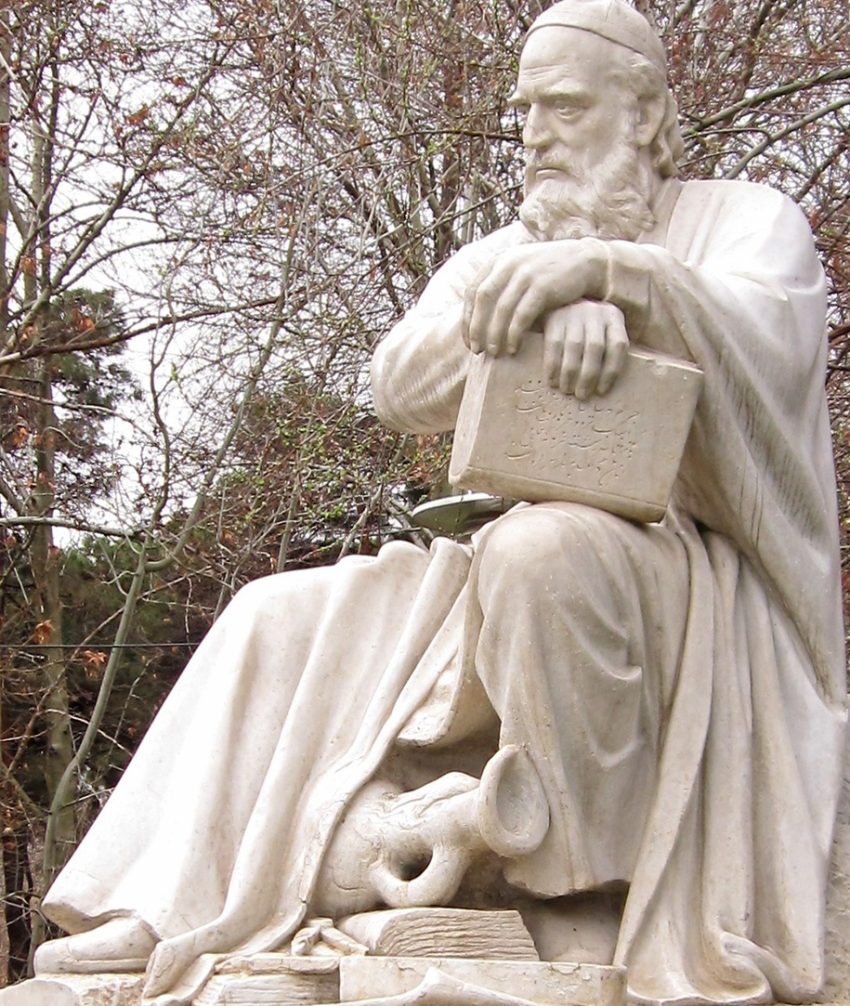
Omar Khayyam occupies a singular and compelling position within the tradition of classical Persian poetry. Although he shares the formal structure of the rubāʿī with many poets of the Persian canon, his philosophical orientation sets him distinctly apart. Unlike figures such as Sanaʾi, Saʿdi, or Hafez, whose poetry is deeply rooted in mystical metaphysics and Neoplatonic cosmology, Khayyam articulates a vision of existence that is strikingly existential in character. His poetry does not frame life as a spiritual ascent toward transcendence or divine union. Instead, it confronts existence as fragile, fleeting, and fundamentally uncertain, privileging the immediacy of lived experience over metaphysical reassurance.
Classical Persian poetry is largely shaped by a cosmological worldview in which existence unfolds as a meaningful progression. Human life is commonly understood as a descent from a higher realm and a return toward an eternal origin. Within this framework, time is teleological, the soul is immortal, and earthly life derives meaning from its connection to an unseen metaphysical order. Poetry thus becomes a vehicle for expressing longing for transcendence, divine love, and spiritual fulfillment. Khayyam, however, resists this inherited structure. His poetry does not assume a preexistent soul, a promised afterlife, or a final spiritual resolution. Rather, he approaches existence with philosophical skepticism and rational clarity, questioning the very foundations upon which metaphysical certainty rests.
This skepticism does not stem from indifference or cynicism but from deliberate and sustained reflection. Khayyam’s poetic voice is neither devotional nor ecstatic. It is contemplative, restrained, and often marked by intellectual distance. He refuses to comfort the reader with assurances of cosmic meaning or narratives of spiritual ascent. In doing so, he dismantles the hierarchical chain of being that dominates much of Persian mystical thought. The universe in Khayyam’s poetry is not layered with symbolic levels or directed toward a divine end. It is immediate, visible, and governed by impermanence. What exists is what can be experienced in the present moment; anything beyond that remains uncertain and ultimately unverifiable.
One of the most striking dimensions of Khayyam’s thought is his treatment of time. In mystical traditions, time is often understood as a pathway toward fulfillment or reunion with the divine. For Khayyam, time possesses no such directionality. Instead, it appears as repetition: birth, brief joy, loss, and death recur without progress or resolution. This cyclical temporality generates a sense of existential fatigue—a melancholic awareness of sameness rather than hope. Life does not move toward transcendence but circles endlessly within the boundaries of mortality. Within this framework, human existence is stripped of any guaranteed cosmic purpose.
Khayyam’s frequent rejection of resurrection, divine judgment, and eternal reward further reinforces his existential stance. In several quatrains, he describes human beings as vessels of clay shaped by a potter, only to be broken and dissolved. This imagery emphasizes contingency rather than destiny. Being is temporary, accidental, and subject to decay. There is no promise of restoration or return to a higher state. Existence, in Khayyam’s vision, is not anchored in eternity but suspended within the fragile immediacy of the present.
This understanding of being resonates, perhaps unexpectedly, with certain strands of Buddhist philosophy. The connection does not suggest historical influence but rather a convergence of philosophical intuitions. Like Buddhist thought, Khayyam’s poetry undermines the notion of a stable, enduring self. Identity is not fixed but constituted through passing moments and experiences. Reality is not a permanent substance but a continuous process of arising and dissolution. Meaning does not lie in salvation or transcendence but in clear awareness of impermanence itself. Life has no definitive beginning or end; it unfolds and fades without metaphysical closure.
Within such a worldview, the question of how one should live becomes central. Khayyam’s response is neither ascetic withdrawal nor reliance on metaphysical hope. Instead, he turns decisively toward the present moment. Awareness becomes the ethical core of his philosophy. His emphasis on the present is not an invitation to reckless indulgence but a thoughtful response to existential uncertainty. When time no longer promises fulfillment and metaphysics no longer guarantees meaning, attentive presence becomes a form of resistance. By fully inhabiting the moment before it vanishes, the individual briefly escapes the monotony of repetition and touches a sense of freedom.
This perspective clarifies the symbolic role of wine in Khayyam’s poetry. Wine is often misinterpreted as a sign of hedonism or escapism. In fact, it functions as a metaphor for awakening and lucidity. In a world stripped of metaphysical assurances, wine represents moments of heightened awareness—instances when illusion dissolves and reality is confronted directly. It is not an escape from existence but an intensified engagement with it. Through wine, Khayyam gestures toward a mode of consciousness that is clear, liberated, and fully present.
Because Khayyam rejects cosmic meaning and metaphysical consolation, some critics have labeled him a nihilist. This interpretation, however, captures only part of his vision. While his poetry exposes the emptiness of grand narratives and denies the promise of eternal salvation, it does not collapse into despair or passivity. On the contrary, Khayyam consistently affirms the value of conscious living. His recognition of the void is accompanied by an insistence on presence. Meaning is not bestowed from beyond but generated through attention, honesty, and engagement with life as it is.
This balance between negation and affirmation prevents Khayyam’s philosophy from becoming destructive. He does not deny life; he strips it of illusion. What remains is not nothingness but freedom. Liberation, in Khayyam’s vision, does not arise through spiritual discipline or mystical ascent. It emerges through acceptance of finitude and clarity of perception. Joy is no longer deferred to an afterlife; it becomes an affirmation of the present, grounded in laughter, friendship, and shared experience. Beauty is discovered not despite impermanence but because of it.
Ultimately, Khayyam’s vision is profoundly humanist. He centers human experience rather than divine transcendence. Mortality, awareness, freedom, and responsibility replace salvation, hierarchy, and cosmic order. He invites the reader to confront existence honestly, without metaphysical shelter, and to live fully within the limits of time. In this sense, Khayyam anticipates many themes of modern existential thought long before its formal articulation. His poetry insists that dignity lies not in eternal purpose but in conscious presence.
In conclusion, Omar Khayyam offers a radical reimagining of existence within the Persian poetic tradition. By rejecting mystical metaphysics and teleological cosmology, he presents life as fragile, repetitive, and uncertain. Yet this rejection does not lead to despair. Instead, it opens a space for awareness, freedom, and joy grounded in the present moment. Wine becomes a symbol of clarity, presence becomes a form of liberation, and joy becomes an affirmation of mortal life. Khayyam’s existential vision remains strikingly modern, urging us to face reality without illusion and to find meaning in the fleeting intensity of being itself.